The Motivation process:
Maslow’s Hierarchy of Needs Theory
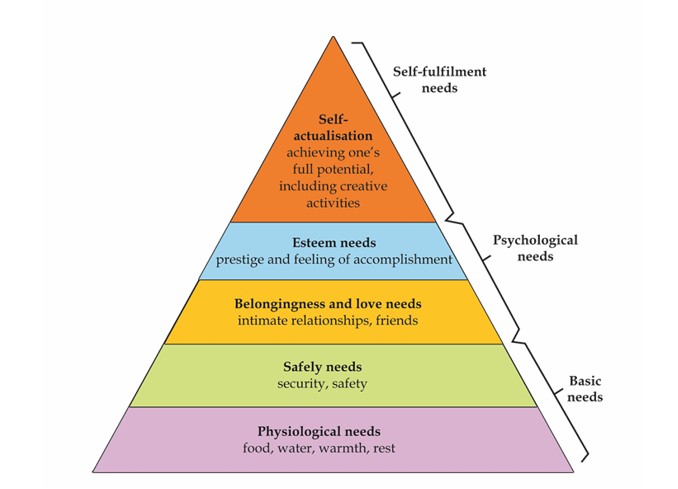
Maslow’s Hierarchy of Needs Theory:
(It’s compulsory to draw this diagram)
This theory was proposed by Abraham Maslow and is based on the assumption that people are motivated by a series of five universal needs. This theory suggests that individuals are motivated to fulfill basic needs before moving on to higher-level needs.
- Physiological Needs (Base of the Pyramid) | These are the fundamental requirements for human survival, including: Food, Water, Shelter, Sleep, and Clothing. Until these needs are met, they dominate an individual’s behavior. Therefore, an entrepreneur should ensure that all their employees receive this amount of basic salary so that their basic needs are fulfilled. For instance, a person experiencing hunger will prioritize finding food over other activities.
- Safety Needs:
Once physiological needs are satisfied, individuals seek safety and security. This includes Personal security, Employment stability, Health and well-being. In the workplace, this translates to job security and a safe working environment. Therefore, an entrepreneur should provide a pension and gratuity facility to their employees, ensuring they feel secure about their future. - Love and Belongingness Needs:
After safety needs are fulfilled, social connections become important. These needs encompass Friendship, Family, and a Sense of connection. In a professional setting, this could mean collaborative teamwork and a supportive company culture. That is why an entrepreneur should create a mix of formal and informal working environments for employees so that they all connect with each other. - Esteem Needs:
At this level, individuals seek Self-esteem, Recognition, Respect from others, Status, and prestige. In the workplace, this is reflected in receiving acknowledgment for achievements and having opportunities for advancement. An entrepreneur should recognise or reward the efforts of his star employees. - Self-Actualization Needs (Top of the Pyramid): This is the realization of one’s full potential and personal growth. Individuals at this stage seek Personal development, the Pursuit of inner potential. In a career context, this might involve pursuing passions, innovation, and striving for excellence. An entrepreneur should help his employees to grow further in the line of authority and help them do certain training, which can help his employees to fully utilise their potential.
- Conclusion: Maslow’s Hierarchy of Needs provides a framework to understand human motivation, from basic survival to self-fulfillment. In entrepreneurship, recognizing these needs can guide strategies for personal development, team building, and business growth.
McClelland’s Theory of Needs
According to David McClelland, regardless of culture or gender, people are driven by three motives. According to McClelland, identifying the needs of your employees and assigning them tasks as per these needs it will motivate them.
– Achievement
– Affiliation
– Power
Need for Achievement: Such individuals are driven by measuring success through personal effort and attaining complex goals. These individuals prefer tasks of moderate difficulty, want quick feedback, and take responsibility.
Entrepreneur Example: Elon Musk—focused on launching transformative ventures like Tesla and SpaceX, driven by a vision and his personal effort to achieve high standards. High achievement need individuals often avoid blind risks but thrive on challenges they can control.
Need for Affiliation: In this need, people get motivated by social connection, belonging, and harmonious relationships. They excel in collaborative settings and value acceptance over high-risk tasks. They get motivated by getting accepted by a group of people or working in a team. For Example, In team-driven startups, co-founders or leaders with high affiliation needs tend to build close-knit cultures, prioritize employee well-being, and foster shared success. Theories suggest these individuals influence positive social environments and cohesion.
Need for Power: In this need, people get motivated by the desire to influence, guide, and lead others. This motivation can be toward personal status or, more productively, toward organizational impact. For Example, Jeff Bezos—he scaled Amazon from a bookstore to a global leader, often shaping industry rules and influencing stakeholders. Bezos exhibits socialized power—using influence to drive collective goals rather than personal ego.
Conclusion: McClelland’s framework helps pinpoint what truly motivates people—whether it’s mastery (achievement), connection (affiliation), or influence (power). Understanding these drives can guide both career growth and team alignment in a business setting.
Difference between an Entrepreneur and an Employee
| Basis | Entrepreneur | Employee |
|---|---|---|
| Motive | To start a venture by setting up an enterprise. | To render one’s service in the ongoing or new enterprise set up by someone else. |
| Status | Owner of the enterprise | The servant in the enterprise |
| Risk Bearing | Assumes all risks and uncertainties involved in running the enterprise | Does not bear any risk; all that can happen is that one may lose one’s job with or without some compensation. |
| Rewards | Profit | Salary |
| Innovations | Acts as an innovator as well as a change agent. | Executes the set plans as per the given schedule |
| Qualification | Needs to possess qualities and qualifications like a high achievement motive, originality in thinking, farsightedness, risk-bearing abilities | Needs to possess a qualification as per the status in the enterprise. |
What Is Intrapreneurship?
The term intrapreneurship was coined by Gifford and Elizabeth Pinchot in 1978.
Meaning of Intrapreneurship: The term refers to acting like an entrepreneur within a firm—turning ideas into value without leaving the company. Unlike entrepreneurs, intrapreneurs invent and take smart risks while using their company’s existing support—like funding, teams, and systems—so they don’t need to build everything from scratch.
Importance/Significance of Intrapreneurship
1. Retains talent: High-potential employees gain fulfilment without having to leave.
2. Drives innovation: Large firms tap internal creativity and agility.
3. Balances risk: Failures are absorbed, and successes benefit the whole company.