On this page
Study guide
Try the problem before reviewing any worked steps or answers provided.
Work through seven numerical problems covering 2D translation, rotation, scaling, reflection, shear and composition, plus a 3D rotation. Use column vectors and take counterclockwise angles as positive in the usual Cartesian plane, with the y-axis pointing up.
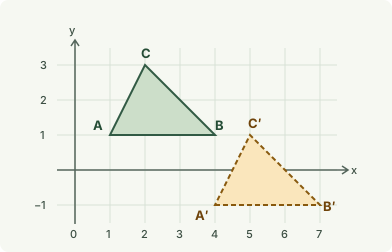
Translate a triangle by (3, −2)
Problem. Translate A(1, 1), B(4, 1) and C(2, 3) three units right and two units down.
Rule. Apply (x′, y′) = (x + 3, y − 2) to each vertex.
| Vertex | Calculation | New coordinates |
|---|---|---|
| A(1, 1) | (1 + 3, 1 − 2) | A′(4, −1) |
| B(4, 1) | (4 + 3, 1 − 2) | B′(7, −1) |
| C(2, 3) | (2 + 3, 3 − 2) | C′(5, 1) |
Rotate a point 90° about a pivot
Problem. Rotate P(4, 2) counterclockwise by 90° about Q(2, 1).
- Subtract the pivot to get the offset (4 − 2, 2 − 1) = (2, 1).
- Rotate the offset using (x, y) → (−y, x). The result is (−1, 2).
- Add the pivot back. P′ = (−1 + 2, 2 + 1) = (1, 3).
For a rotation about the origin, apply the rotation rule directly. For example, (3, 2) becomes (−2, 3).
Scale a point about a fixed point
Problem. Scale P(3, 4) about F(1, 2) by a factor of 2 horizontally and ½ vertically.
- Find the offset from F. Subtract (1, 2) from (3, 4) to get (2, 2).
- Scale that offset to (2 × 2, ½ × 2) = (4, 1).
- Restore the fixed point. P′ = (1 + 4, 2 + 1) = (5, 3).
F stays at (1, 2). Its offset from itself is zero, so the scaling leaves it in place.
Reflect a point across y = x
Problem. Reflect P(−2, 4) across the diagonal line y = x.
Swap the coordinates to obtain P′(4, −2). The midpoint of P and P′ is (1, 1), which lies on y = x. The line joining the two points has slope −1 and is perpendicular to the mirror line.
Apply a horizontal shear
Problem. Apply a horizontal shear with factor 1.5 to P(2, 4).
A horizontal shear uses x′ = x + 1.5y and y′ = y. Substituting gives x′ = 2 + 1.5 × 4 = 8 and y′ = 4, so P′(8, 4). Points on the x-axis stay fixed because y = 0.
Combine scaling, rotation and translation
Problem. Start with P(2, 1). Scale by (2, 3) about the origin, rotate 90° counterclockwise about the origin, then translate by (4, −1).
| Stage | Calculation | Result |
|---|---|---|
| Scale | (2 × 2, 3 × 1) | (4, 3) |
| Rotate | (x, y) → (−y, x) | (−3, 4) |
| Translate | (−3 + 4, 4 − 1) | (1, 3) |
With homogeneous column vectors, multiply the matrices in the order M = T × R × S. The matrix closest to the input vector acts first.
    [0  −3   4]         [0  −3   4] [2]   [1]
M = [2   0  −1]     MP = [2   0  −1] [1] = [3]
    [0   0   1]         [0   0   1] [1]   [1]
Reversing the operations changes the result. Translating first gives (6, 0), rotating gives (0, 6), and scaling gives (0, 18).
Rotate a point about the 3D y-axis
Problem. Rotate P(2, 3, 4) by +90° around the y-axis in a right-handed coordinate system.
The y-coordinate stays fixed. With the right-hand rule for a positive rotation, x′ = z and z′ = −x at 90°. Therefore (2, 3, 4) becomes (4, 3, −2).
[ 0   0   1] [2]   [ 4]
[ 0   1   0] [3] = [ 3]
[−1   0   0] [4]   [−2]